Nov 10, 2007

Skate Detroit

Consider it's a given that Detroit has a problem or two. Every year Detroit demolishes about 2000 vacant homes considered dangerous to the community, and another 2500 become vacant. Currently, there are 15ooo vacant lots in the possession of the city of Detroit, in which it cost 4 million dollars yearly for the city to maintain. In addition, the city consistently ranks in the top 10 most dangerous cities and top 10 poorest cities in the United State. There are very few places children and teens can go to stay out of trouble and do something productive.

It's easy to look at these things as liabilities, creating a city famous for death and destruction. The Detroit trap isn't money, it isn't race, it's a viewpoint. A viewpoint which chokes the city endlessly. The city has been dying for 60 years now. So it's just a wasteland right, let it fester, move away as quick as possible. Like a gazelle being left for dead after a lion has it's way, the city sits and rots. The gazelle no longer has a purpose to this earth, it lived got caught in a bad situation, and now it's the end. But wait, so the gazelle is dead, but has it nothing left to offer? Once the lions have cleared, buzzards will soon flock, picking through the left overs, then the crows, then perhaps another lucky animal that happens upon it. Still, the animal will continue to decay, now lending it's remaining nutrients to the local vegetation and insects, which will in turn provide food for other animals. Finally, the gazelle will become earth, again one with mother nature. Though it may have seemed that the gazelle was worthless, useless, purposeless after it's fatal run in, it is clear that the animal still had much to offer to the community through it's remains, bringing new life to the inhabitants.

Skate parks originated in the streets and parking lots of America. Teens would build ramps and courses out of anything they could find. Sliding down handrails, jumping up on concrete benches, building ramps out of garbage cans and found materials. For years, the skateboard culture was seen as a menace to society. In the 90's, the movement began to gain acceptance, people were taking to these makeshift skate parks on boards, bikes, and skates. Soon these activities became dignified sports, gaining mass media attention through major TV carriers like ESPN and ABC. Communities began to realize that these activities could actually be constructive and keep kids from getting into trouble. Positive role models emerged like Tony Hawk and Dave Mirra. Skate parks began to spurt up all over the nation, in community parks and recreation centers. Companies began making brand new ramps and parks out of wood and plastic. These parks have been full for years, providing America's youth a place to constructively engage in activities helping to keep them off the streets and off of drugs. Though these pre-made skate parks draw neighborhood skaters, many skaters claim that the best parks are those that most resemble the days of the street skater, with picnic tables and abandoned cars. Detroit doesn't have any skate parks but they do have abandoned cars and abandoned buildings.

If you proposed to City council to build a skate park, they would simply laugh at you saying, "We don't have money to pay our cops, why on EARTH would we build a skate park!?" Then you tell them it could begin to solve all there problems, and they would laugh even harder. What would a skate park have to offer a community ridden with abandoned house and vacant lots? A chance perhaps? A renewed purpose??

Well lets see, the obvious benefit, as stated above, would be getting youth off of the dangerous streets and into a positive environment where they can interact with other youths and compete in individual sports, improving their abilities, as well as their confidence and character. What else can a skate park do? Well, if it's good enough, it could attract teens from neighboring cites and suburbs to the city. People keep leaving Detroit, it would be nice to give them some reasons to at least visit. If it was really good, it could even attract national attention and people from all over the world might come just to skate at this park. This would certainly help local businesses, bringing people into town means hotels, restaurants, and shops have increased traffic, the common effects of tourism. "But this is clearly out of the question, we would need tons of money and space to create something like this." Detroit, clearly doesn't have money, but it sure does have space.

So basically, a skate park could be great for Detroit but the city definitely doesn't have the money or time to even consider an undertaking such as this. All of their time and capital is tied up in demolishing all the dangerous abandoned houses that just never seem to go away. Well, what if building a skate park could somehow help the city in the demolition of houses and somehow save the city money. "Well that's just preposterous, you have GOT to be kidding me. This is just getting out of hand... I can see how a skate park might help the youth but I really don't see how it could possibly Save us money, and magically demolish abandoned houses!" At this point, you would be thrown out of the city council meeting.

But, out of curiosity, lets take a look at this idea. Obviously, a brand new, professionally built, out of the box skate park would be very expensive, especially if were talking about making one of the best in the United States. But, we've already seen that skaters actually prefer skate parks that contain elements of the street, parks that are clearly built by skaters and not by contractors. Parks which consist of stairs, cars, handrails, and not just pre-manufactured ramps arbitrarily placed on a slab of concrete awkwardly cut into a suburban landscape. Using this logic, it's safe to assume that a great skate park would be one that uses street elements and is designed by the skaters who will be using the park.

Detroit's many abandoned streets are full of elements that could easily be used by skaters to make a park. Railings could be used for grind rails. Houses could be dismantled and the wood could be used to build ramps. Doors can form walls and transfer boxes. Pitched roof trusses are basically ramps in themselves and we have plenty of those. Detroit has enough vacant land that it could easily give a portion large enough to create the largest skate park in the US, and save money by doing so. Skaters would jump at the opportunity to build their own skate park. A skate park, built by skaters for skaters, out of reused elements from Detroit's many abandoned streets. Carpenters, architects and community members would volunteer to help in the effort, suburban teens would drag their parents out to help. A skate park, built out of the community, by the community. Dozens of houses would be razed without any cost to the city, saving approx. 4000 dollars a house that the city would have to pay to have it demolished. People would come from the suburbs, from the US, from Europe, to see and skate on America's largest and greatest skate park.

Now, it's important to note that a skate park isn't the answer to the problems in Detroit, rather the mindset that a skate park could actually help. The perspective in which the city and it's constituents, both animate and inanimate, are hopeless. Change takes heart, it takes people, not money. Though the gazelle may be dead and seemingly empty of life, it's really just beginning to serve it's community.

NEEDS: Citations, more evident examples, Web 2.0 connections, pictures

Nov 4, 2007

Reverse Logic

The role reversals present in the work pace and living space of today’s design conscious consumers.

The Now: Industrial spaces turned living spaces.
Brick warehouses and concrete factories are all the rage as developers rush to convert these former work floors into raw living spaces. These new loft spaces provide a space where people have the complete freedom to make it their own yet at the same time, maintain a unique history and a storied past. The loft also provides for a flexibility which has not been rivaled by the McMansions of the suburbs. It has come to the point where developers are even building Lofts, which completely lends itself to the freedom of space as a new building lacks in heritage and the character of a storied past. This evidence firmly cements the idea of warehouse living as a true viable trend in housing and begins to redefine the social boundaries of housing.

The Future: Single-family homes turned office space.

Single family homes are generally a combination of many different functional spaces put together to form a house. Small Businesses are generally made up of many different functions rolled up into small job positions requiring individual spaces. As you can see, a single family home could easily be adapted to fit the needs of a small business. Furthermore, the spaces created are much more human and have the capacity to make much more friendly work environments then the factories we are so used to seeing.

Currently, we are in an era of small businesses, with 4+ million businesses having less than 10 employees. More and more consumers are turning into producers, taking advantage of the huge advancements in ecommerce and the vital tools that once were only garnered by Big business, now available to the public. For examples, see Trend Watchings article on Minipreneurs. In a city like Detroit, with neighborhoods full of abandoned housing, it makes sense to redefine the single house for small businesses. This will allow for small business growth and for the habitation of abandoned buildings. Also, as the business grows it can simply take on more abandoned houses in the neighborhood or opt to move to a larger space. On the opposite end of the spectrum, many start ups are home businesses and there is a large movement toward the “work at home” mentality thus supporting the idea of working out of a structure, where you could easily live as well. Finally, if you havn't noticed, suburban offices are looking more and more like traditional residences solidifying the idea that residential space can be more comfortable and inviting to small businesses.


Sep 11, 2007

Every evening that I get a chance to sit down over dinner, I look at my Mint Salt and Pepper shaker. There is something so beautiful about not only the shapes and the fact that they interlock as if to hug, and not just because they are black and white. Somehow, these elements together make such a powerful statement. Sometimes I spread them apart as if they are longing for each other.


Today I was inspired to exploit this beauty in a series of pieces that will target the issue of diversity. The pieces will involve a potent choreography of timing and rhythm. The medium will be stop motion video. The three pieces will be different but should read as a coherent set. The music will be very very important and perhaps the most difficult part of the process.

First I must determine the context of each piece. What it is meant to convey. Then I will predetermine the goals of the piece and the choreography. Then I'll choose the music which best suits the piece. After listening to it over and over again and studying it's highs and lows I will begin to choreography the scene. Once the general idea is captured, the whole script needs to be written in terms of each individual shot and what happens.

Jun 7, 2007

Lighter Kitchens

Alright, now I know I'm probably going to take alot of flack for this because it may seem extreme. That's probably not the best way to start a blog entry but just really think about what I'm bout to say.

Kitchens should not have lights.


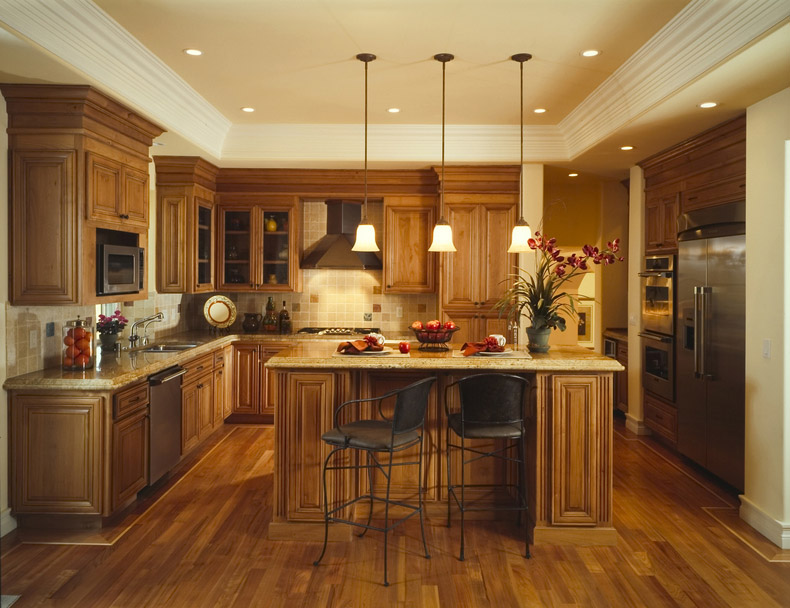
In todays society, the kitchen has become a gathering space for people to congregate. Everyone has a kitchen with an eat-in counter top with some bar stools, or better yet, the new thing is to put a desk in your kitchen to do bills at and such. It seems as if the purpose of the kitchen is no longer to prepare food; the kitchen is the new living room. If your kitchen didn't cost 20,000 +, it must not be a very nice kitchen, that's the ideology anyways. Lavish materials fill these new entertainment spaces such as granite; not for any functional purpose but because it looks good and the homeowner can show it off. I mean this kitchen has more wood then the library from Clue and the ceilings are higher than my entire house. So, what does this have to do with light?? Well, getting rid of lights is the solution and we've just scratched the surface of the problem.

Being that America is the most overweight country in the world, and we are desperately trying to be healthier, maybe it's time we move the entertaining out of our food filled kitchens and into, say, the living room. Why does it make sense to have a desk in the kitchen; and if you have a desk in your kitchen I KNOW you have a home office. The point is, we should not be spending so much time in the kitchen where food is surrounding us at all times. Spending large amounts of time in the kitchen can lead to bad snack forming habits.

Another bad food habit is late night snacking. With todays kitchen being showpieces, they tend to be lit up to a degree unsurmountable by any other room in the house. Therefore, we usual gravitate there in the evening. Even if you are in another room, the kitchen draws your attention, reminding you of food, maybe it's just subconscious but it's there. This leads me to the conclusion that kitchens should only be lit by natural light. Now, you're thinking, "but how are we going to see at night?" According to many reputable doctors and the website LifeScript, it is unhealthy to eat after 9pm and the later you snack the higher your risk of making poor diet choices are. By removing lights from the kitchen, we are lessening the temptation if not at least making it more difficult to indulge in late night snacking.

Now, some of you are thinking, "but sometimes I have to work late and I can't get home till late." Well, waiting till 9 to eat dinner is unhealthy in itself so you probably should take a break from work and grab a bite to eat, or pack a salad. That way, when you arrive home, you will already have eaten dinner. Also, if you have a family, making a habit of returning home after dark every night may be taking it's toll on your loved ones, so perhaps this can be a motive to arrive home on time, and have a consistent family meal time.
Now, I realize this isn't for everyone. For instance, people who live in Alaska, or a climate that has a high fluctuation of daylight hours. Or for those of you who routinely work a night shift. But this is about a lifestyle choice. Obviously everyone doesn't lead the same life or choose the same lifestyle, and that's great; it's called diversity. But for those who choose to lead a healthy, sustainable life, with a regular diet, then this might be a choice to consider.

Lightless Kitchens offer the following:

.Energy Savings
.Food Savings
.Regular Diet
.Healthy Eating Habits

The only light I would leave on in the kitchen is the fridge water dispenser light. Some people need a glass of water before bed. Also, if you are thirsty, and you see the light, you'll think water, not pop or Kool-aid. Another healthy side-effect of the lightless kitchen. As you can see, the majority of the problem is psychological and can be solved with a simple rearrangement of motivations through a simple psychological device: light.


So, kitchen should be designed to be efficient for their function and allow for great natural day light. Mies van der Rohe's Farnsworth House in Plano Illinois is a great example of a functional kitchen with great natural light. It's not a gathering place, forcing residents to gather in the places designated for relaxation and conversation.

Jun 6, 2007

Greening Green

2

"Jeff Gallo of Minneapolis is trying to build a green house. The zoning bylaws were no help, but after a quick redesign by John Dwyer of Shelter Architecture he is on his way and intermittently blogs it for our viewing pleasure."1 It's great to see they are taking the time to blog about the adventure they have embarked on; it allows the public a little porthole into the trials and tribulations of building a green home and also how satisfying it can be when construction is complete. It's great documentation as well as an educational tool. I wish someone blogged about the construction of my apartment complex, tho I don't know that SOM had computers in 1956...Anyways John and Jeff posted an image of there on-site dumpster which was impressively bare, as seen here.

2

Looking at this picture, all I could think of was, those truss ends look really cool, I bet somehow they could still be used. So I designed a shelving unit out of the materials I counted in the image:

12 Truss ends
1 sheet 3/4" plywood (guessing)


Marker Sketch

3D Sketch

Elevation + Objects

Some might say it's nit picky to say even the smallest scraps should be used, but imagine if your site didn't even need a construction dumpster. No truck to bring it in, no truck to take it out, virtually no waste to the landfill. That would be pretty amazing. That aside, what makes this idea green?:

a. 1 left shelving unit that has to be made out of raw materials then shipped to the site (carbon footprint + deforestation, etc.)

b. less materials headed for landfills.

What makes this idea

No discredit to John and Jeff's efforts by any means, their building is Platinum baby! Keep up the great work guys. LEED Certified doesn't mean anything these days, but this, Platinum, is the real deal.

1 Quote from Treehugger
2 Image from 5ive